


Remote Hiring Fraud: The New Playbook and How to Stop It
Remote hiring has opened the door to incredible talent, faster time to fill, and more flexible teams. As more roles move online, smart companies are also updating how they confirm that the person they interviewed is the same person they onboard. The FBI has warned that deepfakes and stolen personal information are being used in some remote job applications and interviews, particularly for roles with access to sensitive systems. The U.S. Department of Justice has also described cases involving coordinated identity misuse in remote IT work, which is another reason many organizations are adding a few simple verification steps to protect employees, customers, and company data.
This playbook walks through practical, low-friction ways to strengthen remote hiring without slowing it down or making the process uncomfortable for good candidates.
What remote hiring fraud looks like today
Remote hiring fraud usually shows up in a few repeat patterns.
- Synthetic or stolen identity use. The data looks plausible on paper, but the person behind the screen is not who they claim to be.
- Deepfake interviewing. Video or voice can be manipulated to make an imposter appear legitimate.
- Technical mismatch. The candidate’s story says one location, but connection behavior suggests another, or multiple candidates share the same device footprint.
- Onboarding and I-9 weakness. When document review is informal, fraudsters take advantage of inconsistent steps.
The fraud chain you need to break
Remote hiring fraud tends to follow a predictable sequence. It starts with a targeted remote posting, then a polished application, then a coached or manipulated interview, then rushed offer acceptance, then onboarding shortcuts, and finally system access where the payoff happens. The goal is to add smart friction before access is granted.
How to stop it without slowing hiring
Set expectations up front
Add one sentence to job postings and interview invitations stating that identity verification occurs at multiple stages, including live verification during onboarding. Clear expectations deter the easiest attempts and keep legitimate candidates informed.
Make interviews deepfake-resistant
Use one short, consistent interaction that is hard to fake in real time.
Add a 30 to 60 second interactive liveness moment. Ask the candidate to turn their head, adjust position slightly, or change lighting. Then ask them to repeat a short phrase you choose on the spot.
For higher-risk roles, add a second brief video touchpoint with a different interviewer. Fraud operations often struggle to maintain continuity across multiple live interactions.
For technical roles, require a live skill demonstration with screen share and narration. This validates competency and identity continuity at the same time.
Lock down offer-stage changes
Treat same-day changes to direct deposit as a step-up event. Verify changes using a separate channel and a known good phone number before updates take effect.
Tighten onboarding and I-9 handling
Avoid ad hoc document handling such as texting photos of IDs. Standardize your onboarding steps and keep document handling inside secure systems.
If you use remote I-9 document examination, align your process to DHS-authorized alternatives and train staff to recognize basic document fraud and escalate quickly.
Contain risk on Day 1
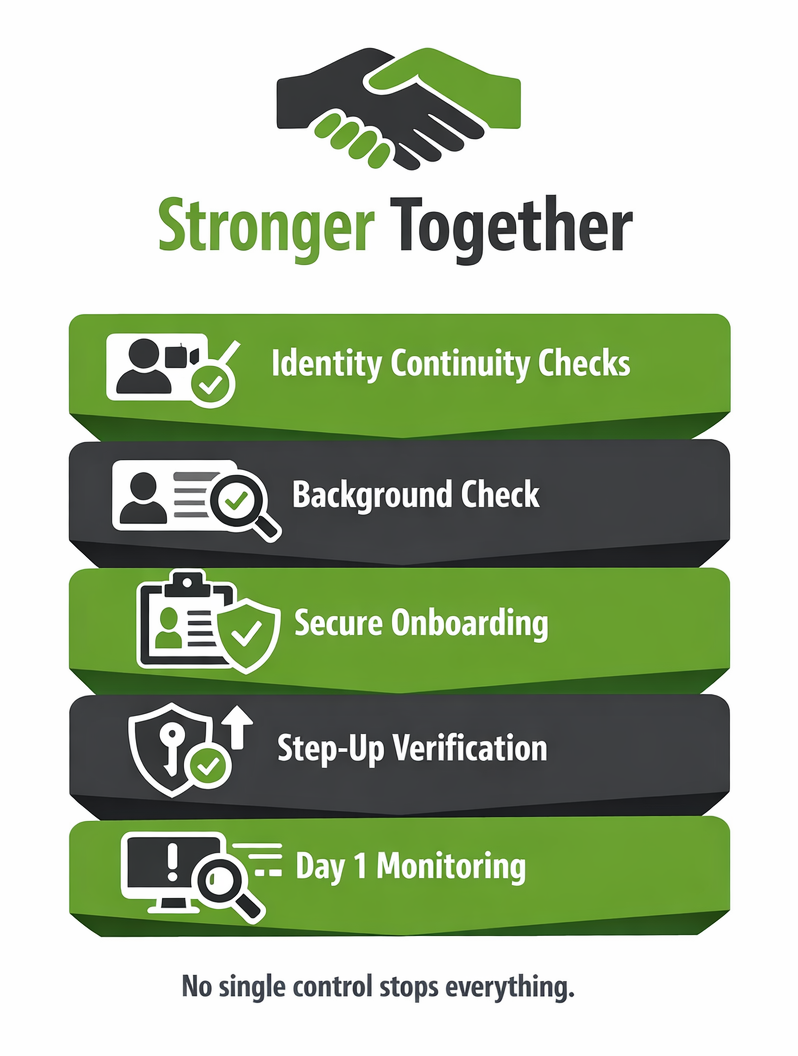
Give least-privilege access on Day 1 and require step-up verification before granting sensitive access such as admin rights, finance approvals, production credentials, or broad customer data access. Monitor early anomalies like impossible travel logins, unusual hours, or repeated device patterns.
Red flags worth escalating
Escalate when a candidate resists live video only during identity moments, when audio and lip movement do not align, when there is unusual urgency around shipping and payroll, or when a third party consistently speaks or controls the process.
If you suspect you hired a fraudulent remote worker
Pause access first. Preserve logs and communications. Re-verify identity using your established, consistent process. If indicators align with coordinated schemes such as laptop farms, involve counsel and follow your incident response plan.
How a proper background check helps prevent remote hiring fraud
A well-built background check helps reduce remote hiring fraud by confirming the candidate has a real, consistent identity history and by surfacing mismatches early.
Focus on three things: verify identity basics first so the search is tied to the right person, use the SSN trace and address history as a consistency check to spot “too new” or conflicting footprints, and add employment or education verification for higher-access roles where polished resumes are easiest to fake.
Background screening works best when paired with same-person continuity checks at offer and onboarding, so the person you screened is the person who shows up on Day 1.
Key Takeaways
- Add identity continuity checks at key moments so the person you interview is the person you onboard.
- Use a short liveness moment in interviews, and add a second touchpoint for high-access roles.
- Standardize onboarding and keep identity documents in secure systems, not texts or personal email.
- Start Day 1 with least-privilege access and step-up verification before sensitive permissions.
- Use a proper background check to confirm consistent identity history and flag mismatches early.
Have questions? Speak to a Private Eyes expert for more information.