


Borrower Verification in Lending: Why It Matters and How It Works
In today’s fast-moving lending environment, speed is important, but accuracy is everything. Lenders are under constant pressure to close loans quickly while protecting themselves from fraud, repurchase risk, and compliance violations. Borrower expectations have also shifted. Many applicants expect a seamless digital experience, which can sometimes create tension between convenience and proper due diligence.
At the same time, the risk landscape has evolved. Fraud schemes are more sophisticated, documentation can be manipulated more easily, and regulatory scrutiny remains high. This means lenders cannot afford to rely on surface-level checks or incomplete data. A strong verification process is no longer optional. It is a core part of responsible lending operations.
That is where borrower verification comes in. It serves as the foundation for making sound lending decisions by ensuring that every piece of critical borrower information is accurate and defensible. Understanding what borrower verification includes, and why it plays such a vital role, can help lenders improve both efficiency and risk management.
What Is Borrower Verification?
Borrower verification is the process of confirming that the information provided by a loan applicant is accurate, complete, and legitimate. It is not just a single step in the workflow. Instead, it is a structured approach that combines multiple checks to validate a borrower’s identity, financial position, and overall credibility.
This process is designed to give lenders confidence in the data they are using to make decisions. Rather than relying solely on documents provided by the borrower, verification involves independent sources and third-party tools that confirm the information is consistent and trustworthy. This reduces the likelihood of errors, misrepresentation, or intentional fraud.
This process typically includes:
- Identity verification, confirming the borrower is who they claim to be
- Income verification, ensuring the borrower has the ability to repay
- Employment verification, confirming job status and stability
- Tax transcript verification, validating reported income with IRS records
- Fraud screening tools, detecting inconsistencies or synthetic identities
When done correctly, borrower verification creates a clear and defensible picture of the applicant. It allows lenders to move forward with confidence, knowing that the loan decision is based on verified and reliable information rather than assumptions or incomplete data.
Why Borrower Verification Matters
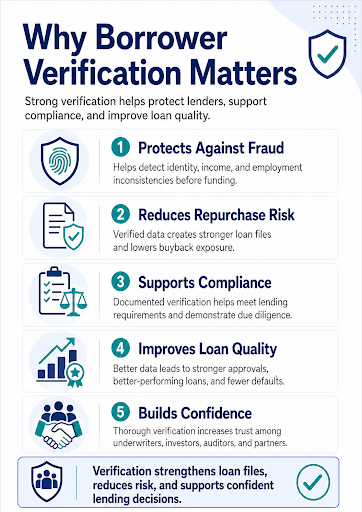
- It protects against fraud
Fraud tactics have become more sophisticated, especially with synthetic identities and digital applications. Borrowers can present documentation that appears legitimate on the surface, but without proper verification, it can be difficult to detect inconsistencies.
A layered verification process helps identify red flags early. By cross-checking identity, income, and employment data against trusted sources, lenders can catch issues before they turn into financial losses. This proactive approach is far more effective than trying to resolve fraud after a loan has already been funded.
- It reduces repurchase risk
Incomplete or inaccurate loan files are one of the leading causes of loan buybacks. Investors expect loan files to be fully documented and supported by verified data. When gaps are discovered, lenders can be required to repurchase the loan, which creates significant financial exposure.
Verification tools, especially IRS transcript validation, help ensure that the information used during underwriting is accurate and consistent. This creates a stronger, audit-ready file that can stand up to investor review and reduces the likelihood of costly repurchase demands.
- It supports compliance
Regulations require lenders to verify key borrower information as part of responsible lending practices. Compliance is not just about checking boxes. It is about demonstrating that proper procedures were followed and that decisions were based on verified data.
Under Regulation B (12 CFR 1002.6), lenders must evaluate applicants using information that is applied consistently and without discrimination. This makes accurate and well-documented verification processes essential, not just for risk management, but for compliance.
Failing to meet these requirements can result in audits, penalties, and reputational damage. A well-documented verification process helps lenders stay aligned with regulatory expectations while also creating a clear record of due diligence that can be reviewed if needed.
- It improves loan quality
Better data leads to better decisions. When lenders rely on verified information, they are more likely to approve borrowers who truly meet the necessary criteria. This leads to stronger-performing loans and fewer early payment defaults.
Over time, improved loan quality contributes to a healthier portfolio. It allows lenders to manage risk more effectively and maintain confidence in their underwriting standards, even as market conditions change.
- It builds confidence across the process
From underwriters to investors, every stakeholder relies on the integrity of the loan file. When verification is thorough and consistent, it creates trust at every stage of the lending process.
This confidence extends beyond internal teams. Secondary market investors, auditors, and partners are more comfortable working with lenders who demonstrate strong verification practices. That trust can translate into smoother transactions and stronger long-term relationships.
The Bottom Line
Borrower verification is not just a box to check. It is a foundational part of responsible lending that directly impacts risk, compliance, and overall performance. Lenders who take verification seriously are better positioned to navigate challenges and avoid costly mistakes.
By investing in a structured and reliable verification process, lenders can strike the right balance between speed and accuracy. This not only protects the organization, but also supports better outcomes for borrowers and stakeholders alike.
Key Takeaways
- Borrower verification is a multi-step process that confirms identity, income, employment, and overall borrower credibility
- Relying on verified data instead of borrower-provided documents alone reduces errors and strengthens decision-making
- Strong verification processes help detect fraud early and prevent costly financial losses
- Accurate verification plays a critical role in reducing repurchase risk and creating audit-ready loan files
- Compliance depends on consistent and well-documented verification practices
- Higher-quality data leads to better-performing loans and fewer early defaults
- Thorough verification builds confidence with underwriters, investors, and regulatory bodies
- Investing in the right verification tools and workflows helps lenders balance speed with accuracy
Ready to transform your lending experience? Contact us to get started and ensure efficiency and reliability in your loan approval processes.
Have questions? Speak to a Private Eyes expert for more information.