


FCRA-Compliant Background Checks: What Employers Need to Know
Background checks are an important part of making informed hiring decisions. They can help employers verify qualifications, protect employees and customers, reduce risk, and maintain trust within an organization.
But when an employer obtains a background check from a third-party consumer reporting agency, the process is generally subject to the Fair Credit Reporting Act (FCRA). Employers must follow specific procedures before requesting a report and before taking certain negative employment actions based on information in that report.
Understanding these requirements can help HR teams and hiring managers build a screening program that is both effective and compliant.
What Is the FCRA?
The Fair Credit Reporting Act is a federal law governing how consumer information is collected, reported, and used.
In the employment context, a background report obtained from a company that compiles information about individuals may qualify as a consumer report under the FCRA. These reports can contain information such as:
- Criminal history
- Employment history
- Education verification
- Credit history, when legally permissible and appropriate
- Driving records
- Professional licenses
- Other information relevant to employment
The FCRA can apply to employment decisions involving not only hiring, but also retention, promotion, and reassignment.
Step 1: Provide a Clear, Stand-Alone Disclosure
Before obtaining an employment background report, an employer generally must tell the applicant or employee that a consumer report may be obtained and used for employment purposes.
The disclosure must be clear, conspicuous, and presented in a stand-alone format. According to FTC guidance, the disclosure should not be buried inside the employment application or surrounded by unrelated information that could distract from its purpose.
This is one area where seemingly small paperwork mistakes can create unnecessary compliance exposure. Employers should review their disclosure forms periodically and avoid adding unrelated acknowledgments, waivers, releases, or excessive language to the FCRA disclosure.
Step 2: Obtain Written Authorization
Employers generally must obtain the applicant’s or employee’s written permission before requesting a consumer report for employment purposes. The authorization may be included with the disclosure when appropriately structured.
If an employer intends to obtain additional consumer reports during an individual’s employment, the authorization and disclosure should clearly address that possibility.
Employers should also ensure that their background screening provider receives the required certifications confirming that the employer has followed applicable FCRA requirements.
Step 3: Use Background Information Consistently and Responsibly
FCRA compliance is only one part of a legally sound background screening program.
Federal equal employment opportunity laws also affect how employers may use background information. The Equal Employment Opportunity Commission advises employers to apply screening standards consistently and avoid practices that unlawfully discriminate against applicants or employees based on protected characteristics.
When evaluating criminal history, for example, the EEOC recommends considering factors such as:
- The nature and seriousness of the offense
- How much time has passed since the offense or completion of the sentence
- The nature, responsibilities, and risks associated with the position
An arrest by itself is not proof that an individual committed a crime. Employers should therefore be cautious about automatically disqualifying applicants based simply on an arrest record.
A well-designed screening policy should connect the information being reviewed to legitimate requirements of the position rather than relying on blanket exclusions.
Step 4: Follow the Pre-Adverse Action Process
One of the most important FCRA procedures occurs when an employer is considering a negative employment decision based in whole or in part on information contained in a consumer report. Examples can include deciding not to hire an applicant, terminating an employee, or declining a promotion.
Before making that decision final, the employer must provide the individual with a pre-adverse action notice that includes:
- A copy of the consumer report relied upon; and
- A copy of the required Summary of Your Rights Under the Fair Credit Reporting Act.
This step gives the applicant or employee an opportunity to review the information and identify possible errors before the employer finalizes its decision.
Employers should use the current version of the CFPB’s prescribed Summary of Consumer Rights rather than relying indefinitely on an old form stored in an HR folder. The CFPB maintains the prescribed form under Regulation V.
Step 5: Give the Individual a Meaningful Opportunity to Respond
After sending the pre-adverse action materials, employers should allow the individual a reasonable opportunity to review the report and raise a dispute before taking final adverse action.
This is important because background reports can occasionally contain incorrect, incomplete, outdated, or mismatched information.
For example, an applicant may identify:
- A criminal record belonging to another individual with a similar name
- Incorrect dates or case dispositions
- Employment information that was reported inaccurately
- Information that has been expunged, sealed, or otherwise should not appear
- Identity-related errors
A documented process for handling disputes helps prevent rushed decisions and gives employers an opportunity to base employment decisions on more accurate information.
Step 6: Send the Final Adverse Action Notice
If the employer completes its review and ultimately decides to take adverse action based on the consumer report, the FCRA requires another notification.
The final adverse action notice must provide certain information, including:
- The name, address, and telephone number of the consumer reporting agency that supplied the report
- A statement explaining that the reporting agency did not make the employment decision and cannot explain the employer’s specific reasons for it
- Notice of the individual’s right to dispute the accuracy or completeness of information in the report
- Notice of the individual’s right to obtain another free copy of the report from the reporting agency if requested within 60 days
Employers should keep records showing that both the pre-adverse and final adverse action procedures were properly completed.
State and Local Laws Matter Too
FCRA compliance does not automatically mean an employer’s screening program complies with every applicable law.
States and municipalities may impose additional requirements concerning matters such as:
- When employers may ask about criminal history
- Which criminal records may be considered
- Credit checks for employment purposes
- Required notices
- Individualized assessments
- Waiting periods
- Applicant rights during the hiring process
The FTC and EEOC both advise employers to consider applicable state and local requirements in addition to federal law.
Employers operating in several jurisdictions should be particularly careful about using a single nationwide screening workflow without first determining whether additional local requirements apply.
Investigative Consumer Reports Require Additional Attention
Some employers use more detailed reports based on interviews with people who know the applicant or employee. Under the FCRA, these may qualify as investigative consumer reports.
Additional disclosure obligations can apply when these reports are requested, including informing the individual about the nature of the investigation and certain rights relating to additional disclosures.
Organizations using reference interviews or similar investigative screening services should make sure their procedures address these additional requirements.
Common FCRA Compliance Mistakes Employers Should Avoid
Even employers with good intentions can create problems when background screening becomes an informal or inconsistent process.
Common areas of risk include using an outdated disclosure form, placing excessive language in the disclosure, requesting a report before obtaining proper authorization, skipping the pre-adverse action step, failing to provide the consumer report or Summary of Rights, making the final decision before allowing the applicant an opportunity to respond, and automatically disqualifying applicants without considering applicable discrimination, state, or local requirements.
Consistency is critical. HR staff, recruiters, hiring managers, and outside screening partners should understand who is responsible for every step.
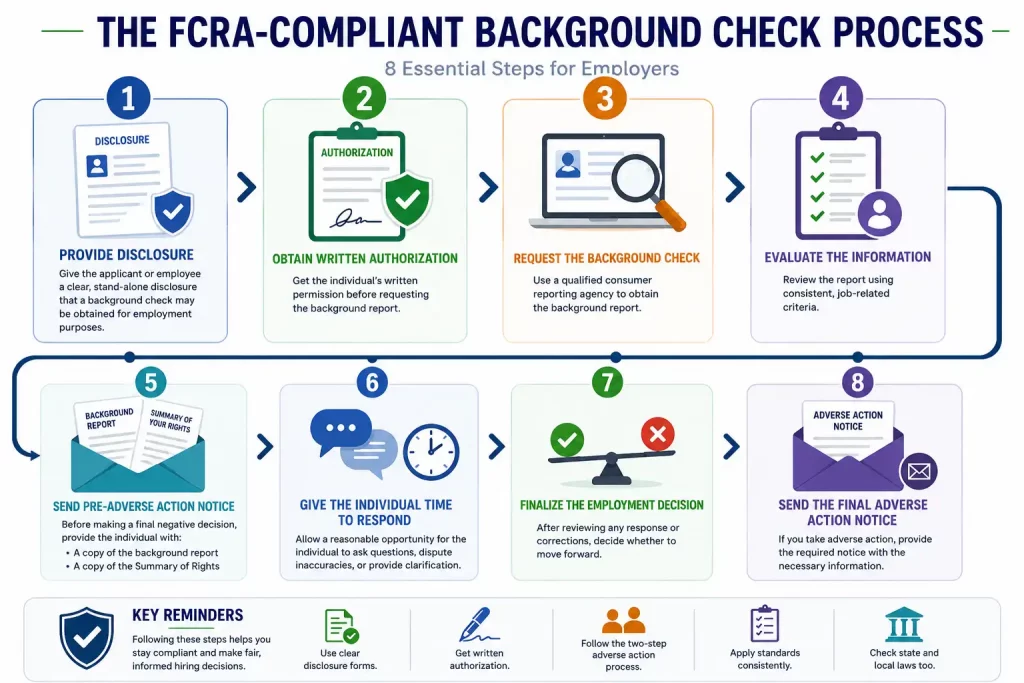
A Simple FCRA Compliance Workflow
Employers can strengthen their screening program by building a repeatable process:
- Determine what screening is appropriate for the position.
- Provide the required stand-alone FCRA disclosure.
- Obtain the individual’s written authorization.
- Request the background report from a qualified consumer reporting agency.
- Review the report using consistent, job-related standards.
- If adverse action may result, send the pre-adverse action notice, report, and current Summary of Rights.
- Give the individual an appropriate opportunity to review or dispute the information.
- Evaluate any corrected or additional information received.
- If adverse action is ultimately taken, provide the required final adverse action notice.
- Maintain documentation and periodically review the process for federal, state, and local compliance.
Compliance Should Support Better Hiring Decisions
A compliant background screening process should not be viewed simply as paperwork. Done correctly, it creates a more reliable decision-making process. Employers receive information relevant to the position, applicants have an opportunity to correct potential errors, and hiring teams operate under clear and consistent standards.
The strongest screening programs combine accuracy, consistency, transparency, and compliance.
Employers should also periodically review their background-check policies, disclosure and authorization documents, adverse-action procedures, and vendor practices. Laws and regulatory requirements can change, particularly at the state and local level.
For organizations conducting background checks at scale, working with an experienced screening provider can help simplify the process and reduce the risk of missed compliance steps. Private Eyes supports employers with reliable background screening and verification services designed to help HR teams make informed hiring decisions while maintaining a consistent, compliance-focused process.
A strong screening partner should feel like an extension of your hiring team—helping you protect your organization while keeping the candidate experience professional and efficient.
Key Takeaways
- Employers using third-party background checks for employment purposes must follow the Fair Credit Reporting Act (FCRA).
- A clear, stand-alone disclosure should be provided before requesting a background report.
- Employers generally must obtain the applicant’s or employee’s written authorization before conducting the check.
- If information in a background report may lead to a negative employment decision, employers must follow the pre-adverse action process before making the decision final.
- Applicants should receive a copy of the background report and the required Summary of Rights so they have an opportunity to review and dispute inaccurate information.
- Employers must provide a final adverse action notice when an employment decision is ultimately made based in whole or in part on the consumer report.
- State and local background-check, ban-the-box, and fair-chance laws may create additional requirements beyond the FCRA.
- Consistent policies, accurate records, trained hiring teams, and a reliable screening partner such as Private Eyes can help employers build a more efficient and compliance-focused hiring process.
Have questions? Speak to a Private Eyes expert for more information.