


IRS Tax Transcript Verification: A Guide for Mortgage and Business Lenders
For mortgage and business lenders, verifying a borrower’s income is more than a documentation exercise. It is an important part of assessing repayment capacity, identifying inconsistencies, reducing fraud risk, and building a defensible underwriting file.
Pay stubs, bank statements, tax returns, and financial statements can all help establish a borrower’s financial picture. But when income verification requires information obtained directly from the Internal Revenue Service, IRS tax transcripts can provide an additional layer of confidence.
The IRS Income Verification Express Service (IVES) allows taxpayers to authorize mortgage lenders, banks, credit unions, and other authorized parties to receive certain tax transcripts and wage information. The IRS provides this information to a third party only with the taxpayer’s consent.
For lenders, understanding how transcript verification works—and how to use it correctly—can help streamline underwriting while strengthening fraud controls.
What Is an IRS Tax Transcript?
An IRS tax transcript is an official record containing tax information maintained by the IRS. A transcript is not the same as a photocopy of a taxpayer’s filed return.
Depending on the transcript requested, it can show information from a filed tax return, subsequent account activity, or income documents reported to the IRS by employers and other payers.
The IRS offers several transcript types, including:
Tax Return Transcript: Shows most line items from the taxpayer’s originally filed Form 1040-series return, including associated forms and schedules. It generally does not reflect changes made after the original return was filed. The IRS notes that this transcript typically meets the needs of mortgage lending institutions.
Tax Account Transcript: Shows basic tax-account information such as filing status, taxable income, payments, and changes made after the original return was filed.
Record of Account Transcript: Combines information from the Tax Return Transcript and Tax Account Transcript into a single record.
Wage and Income Transcript: Shows information reported to the IRS on documents such as Forms W-2, 1098, 1099, and 5498. Because this information comes from third-party reporting, it can be especially useful when a lender needs to compare claimed income with information reported to the IRS.
Verification of Non-Filing Letter: Confirms that the IRS has no record of a processed Form 1040-series tax return as of the date of the request. Importantly, it does not determine whether the individual was legally required to file a tax return.
Choosing the correct transcript type depends on the borrower, the loan program, the type of income being evaluated, and the lender’s underwriting requirements.
Why Tax Transcript Verification Matters to Lenders
A tax return supplied directly by an applicant is valuable, but lenders may want independent verification that information represented in the application aligns with IRS records.
Transcript verification can help lenders:
- Confirm that a tax return was filed and compare relevant information with borrower-provided documentation.
- Evaluate income for self-employed borrowers, independent contractors, business owners, and applicants with complex income sources.
- Compare wage and income information against W-2s or 1099s supplied during underwriting.
- Identify discrepancies requiring additional documentation or explanation.
- Strengthen fraud-prevention procedures.
- Create a more complete underwriting and quality-control record.
A discrepancy does not automatically mean fraud. Differences can result from amended returns, timing, processing delays, reporting errors, or other legitimate circumstances. The purpose of transcript verification is to identify information that may require further review—not to make conclusions without investigation.
How Form 4506-C and IVES Work
For lender-requested income verification through IVES, Form 4506-C, IVES Request for Transcript of Tax Return, is a central part of the process.
The taxpayer authorizes the IRS to provide the requested tax information to the designated IVES participant. The request identifies the taxpayer, the IVES participant, the lender or client receiving the information, the transcript being requested, and the applicable tax periods.
Accuracy is critical. Incomplete or incorrectly prepared requests can be rejected.
Current IRS guidance states, among other requirements, that the necessary taxpayer signatures must be provided, IVES participant information must be completed, and client information is required. The IRS also provides specific instructions regarding tax return and wage-and-income transcript requests.
For business transcript requests, authority to approve the request also matters. The IRS identifies acceptable titles depending on the type of entity, such as certain corporate officers, LLC managing members, partners, trustees, and other authorized persons.
That makes careful form preparation particularly important when verifying income associated with a closely held corporation, partnership, LLC, trust, estate, or sole proprietorship.
Electronic IVES Can Speed Up Verification
The IRS has modernized IVES with online capabilities.
According to current IRS guidance, IVES participants may submit single electronic requests through a Web User Interface or use Application-to-Application functionality for higher-volume workflows. With taxpayer authorization through the taxpayer’s online account, the IRS states that transcript delivery can occur in hours.
The legacy fax process remains available, with the IRS listing a typical processing period of approximately two to three business days.
For lenders working against tight closing deadlines, these electronic workflows can make transcript verification considerably more practical than processes dependent on manual document exchange.
Mortgage Lending: What Should Be Verified?
Mortgage underwriting frequently involves reconciling several sources of borrower information.
Depending on the loan program and borrower profile, that may include:
- Personal tax returns
- Business tax returns
- W-2 forms
- 1099 forms
- Pay statements
- Profit-and-loss statements
- Bank statements
- Employment verification
- IRS transcripts
For a salaried borrower, transcript verification may help support income information already documented elsewhere in the file.
For a self-employed borrower, the analysis can be more complex. A lender may need to evaluate personal returns together with applicable business returns and schedules to understand how income flows from the business to the borrower.
The key is not simply obtaining a transcript. The lender must make sure the correct transcript, taxpayer, tax form, and period are being compared with the documents used to underwrite the loan.
Business Lending: Looking Beyond the Personal Return
Business lending often requires an even broader verification strategy.
A business owner may receive income through salary, distributions, partnership income, rental income, interest, dividends, or other sources. A lender may therefore need to evaluate both the borrower’s individual income and the underlying business.
IRS information can be one component of reviewing:
- Historical revenue and income
- Owner compensation
- Business tax filings
- Reported wages
- Contractor or miscellaneous income
- Tax filing history
- Consistency between borrower-submitted and independently obtained records
IRS transcripts should generally be considered alongside—not automatically in place of—other underwriting documents.
For example, a tax transcript may confirm historical tax information but will not necessarily tell a lender everything needed to evaluate a company’s current liquidity, cash flow, debt obligations, or recent operating performance.
Watch for Timing and Availability Issues
Transcript information is not always available immediately.
The IRS notes that transcript availability may depend on factors such as how and when a return was filed and processed. Wage and Income Transcripts also contain only information documents that have actually been filed with the IRS, so they may not yet reflect every document issued to a taxpayer.
This distinction is important.
“No record” or missing information should not automatically be interpreted as evidence that the borrower provided false information. Instead, lenders should consider the tax period, filing date, IRS processing status, amendments, and whether supplemental documentation is appropriate.
Protecting Taxpayer Information
IRS transcripts contain sensitive financial information and must be handled accordingly.
The IRS masks portions of personally identifiable information on many transcripts while keeping financial information visible for purposes such as income verification. For example, transcripts generally display only the last four digits of a Social Security number or Employer Identification Number.
Lenders and service providers should maintain appropriate safeguards around transcript requests, storage, access, transmission, retention, and disposal.
Access should be limited to personnel with a legitimate business need, and organizations should align their processes with applicable privacy, information-security, regulatory, investor, and record-retention requirements.
Common Mistakes Lenders Should Avoid
A strong transcript-verification process should be designed to prevent predictable problems.
Common issues include requesting the wrong tax year, choosing the wrong transcript type, entering incorrect taxpayer information, submitting an incomplete Form 4506-C, overlooking required signatures, or comparing a transcript with documents that relate to a different taxpayer or entity.
Lenders should also avoid treating transcript verification as a simple pass-or-fail exercise.
When records do not match, the better approach is to identify the discrepancy, determine whether there is a reasonable explanation, obtain supporting documentation when appropriate, and document the resolution in the loan file.
Building a Better Verification Workflow
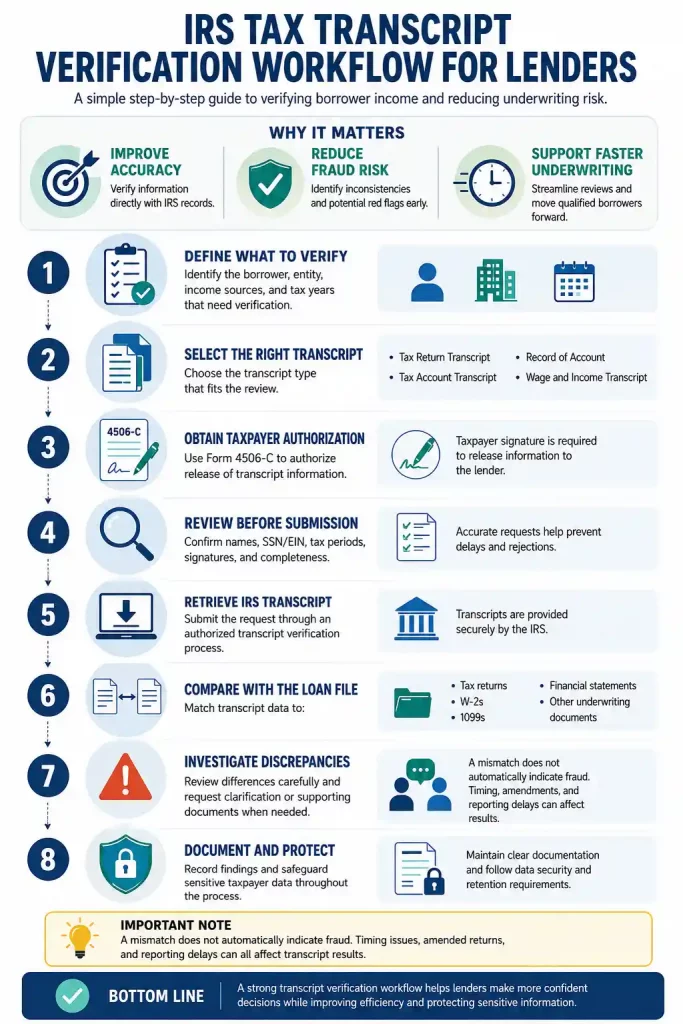
An effective lender workflow can be built around a few consistent practices:
- Determine what needs to be verified. Identify the income source, taxpayer, entity, tax form, and years relevant to underwriting.
- Use the appropriate transcript. Do not request more information than is reasonably necessary for the verification purpose.
- Obtain proper taxpayer authorization. Make sure Form 4506-C and applicable electronic authorization procedures are completed correctly.
- Review requests before submission. Small errors can delay processing or cause rejection.
- Compare the transcript with the underwriting file. Look for consistency across tax returns, W-2s, 1099s, financial statements, employment records, and other documentation.
- Investigate material discrepancies. Give the borrower an opportunity to provide clarification or supporting information where appropriate.
- Document the result. Maintain a clear record of what was verified, any discrepancies identified, and how they were resolved.
- Protect the information. Restrict access and maintain appropriate security controls throughout the lifecycle of the data.
A Smarter Approach to IRS Transcript Verification
IRS tax transcript verification gives mortgage and business lenders another way to validate financial information directly against IRS records—with the taxpayer’s authorization.
Used correctly, it can help lenders make more confident credit decisions, identify inconsistencies earlier, reduce fraud exposure, and move qualified borrowers through underwriting more efficiently.
The greatest value comes from incorporating transcript verification into a broader, well-designed verification process. That means requesting the right records, obtaining valid authorization, understanding what each transcript can and cannot establish, investigating discrepancies carefully, and protecting sensitive taxpayer information throughout the process.
For lenders managing significant loan volume, an experienced verification partner can make the process more efficient. Private Eyes helps lenders streamline Form 4506-C processing, transcript retrieval, workflow integration, and exception management—giving underwriting teams access to the information they need while minimizing unnecessary friction for borrowers.
A reliable verification process ultimately supports faster, more confident lending decisions while helping protect both the lender and the borrower.
Key Takeaways
- IRS tax transcript verification helps mortgage and business lenders validate borrower financial information against records maintained by the IRS.
- Form 4506-C is used to authorize the release of tax transcript information through the IRS Income Verification Express Service (IVES).
- Different transcript types serve different purposes, including Tax Return Transcripts, Tax Account Transcripts, Records of Account, and Wage and Income Transcripts.
- Transcript verification can help lenders identify discrepancies, strengthen fraud-prevention efforts, and support more confident underwriting decisions.
- Self-employed borrowers and business owners may require both personal and business tax information for a complete income analysis.
- Missing or delayed transcript information does not automatically indicate fraud; processing timing, amended returns, and reporting delays should be considered.
- Lenders should protect taxpayer information carefully and maintain clear procedures for authorization, access, storage, and retention.
- 4506-Transcripts.com can help lenders streamline Form 4506-C processing, transcript retrieval, and verification workflows.
Have questions? Speak to a Private Eyes expert for more information.