


Building a Stronger Loan Verification Workflow: Identity, Income, Fraud Prevention, and Compliance
In lending, speed and accuracy have to work together. Borrowers expect efficient decisions, while lenders need confidence that applicants are who they claim to be, their financial information is reliable, and potential fraud risks have been addressed.
A stronger verification workflow connects four essential areas: identity, income, fraud prevention, and compliance. When these functions work together, lenders can reduce risk, improve efficiency, and create a smoother experience for legitimate borrowers.
Start With Strong Identity Verification
Identity verification provides the foundation for the lending process. Before relying on income, employment, tax, or other financial information, lenders need reasonable confidence that they are dealing with the correct person.
Depending on the institution and loan type, verification may include government-issued identification, validation against reliable data sources, and additional authentication when risk indicators appear. Establishing identity early can help prevent questionable applications from moving unnecessarily through underwriting.
Verify Income With Reliable Source Data
Income verification helps lenders determine whether the financial information presented by an applicant is supported by reliable records. While borrower-provided documents are useful, independent verification can provide another layer of confidence.
For participating lenders, the IRS Income Verification Express Service (IVES) allows authorized tax transcript information to be requested using Form 4506-C. Tax transcript verification can be particularly useful for applicants with self-employment income, variable earnings, multiple income sources, or financial circumstances requiring additional documentation.
Make Fraud Prevention Part of the Process
Fraud prevention works best when it is incorporated throughout the verification process instead of being treated as a final checkpoint. Warning signs may emerge through inconsistencies involving identity information, addresses, employment, reported income, tax records, or supporting documents.
A discrepancy does not automatically indicate fraud, but it should be evaluated according to established procedures. Combining identity verification, income verification, and fraud screening helps lenders evaluate information collectively and identify applications that may require additional review.
Build Compliance Into the Workflow
Compliance should be incorporated into verification procedures from the beginning. Lenders should have clear processes for collecting information, obtaining required authorization, performing verification, addressing discrepancies, protecting sensitive data, and maintaining appropriate records.
Requirements can also change, making regular reviews important. Verification procedures, forms, technology, vendor relationships, and employee training should be evaluated against current federal and state requirements, applicable program rules, and organizational policies.
Create a Clear Verification Sequence
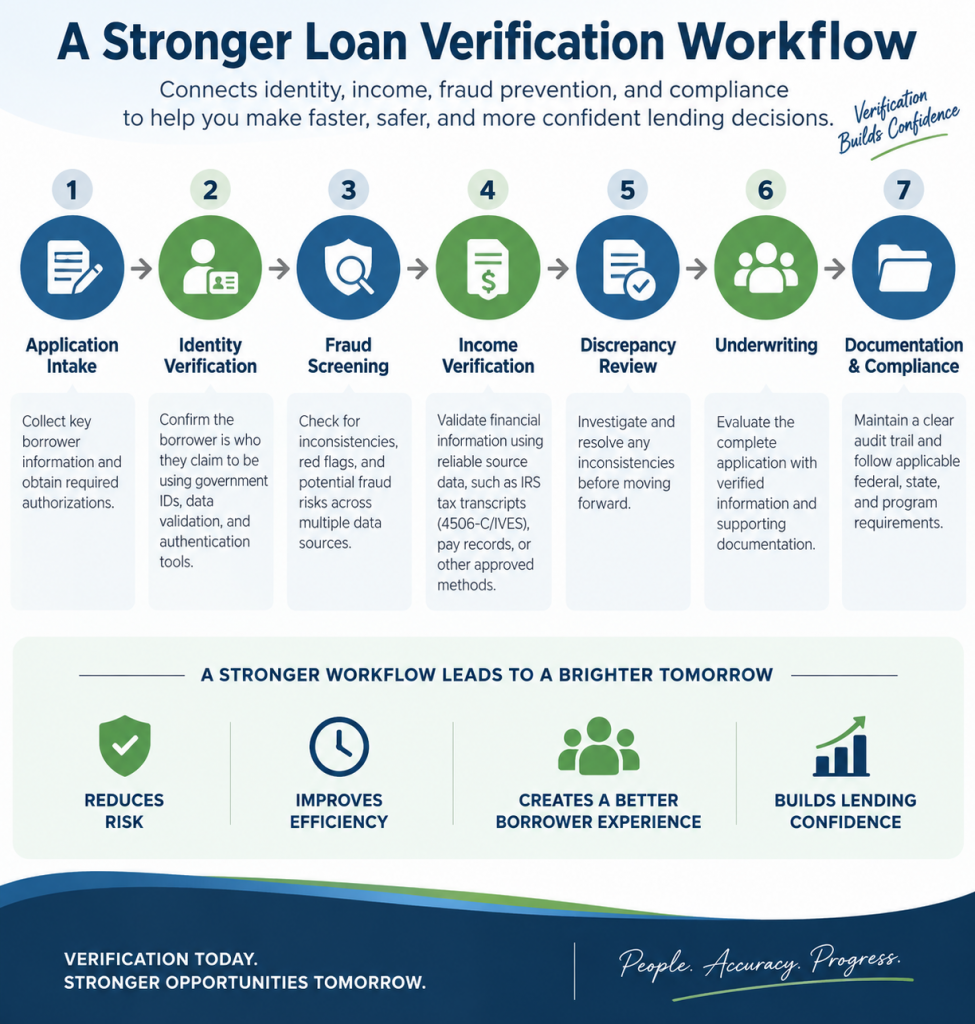
An effective workflow does not necessarily require more verification steps. Instead, lenders can improve efficiency by placing the right checks at the appropriate points in the application process.
A typical sequence may move from application and identity verification to fraud screening, income verification, discrepancy review, underwriting, and documentation. Straightforward applications can continue efficiently, while applications with inconsistencies or elevated risk indicators can be routed for additional review.
Keep Borrower Authorization Simple
Borrowers should understand what information they are authorizing, why it is required, and what they need to provide. Clear instructions are especially important when lenders request third-party information such as IRS tax transcripts.
Errors or incomplete information on authorization forms can create unnecessary delays. Providing borrowers with straightforward instructions and reviewing required information early can reduce rejected requests, repeated paperwork, and avoidable back-and-forth.
Maintain a Reliable Audit Trail
Verification should leave a clear record of what was performed throughout the application process. Lenders should be able to determine what information was requested, what authorization was obtained, what verification results were received, and how discrepancies were addressed.
A reliable audit trail supports compliance reviews, quality control, vendor oversight, and internal investigations. It can also reveal recurring problems that may indicate opportunities to improve procedures, technology, or employee training.
Build a More Connected Verification Strategy
Identity verification, income verification, fraud prevention, and compliance are most effective when they operate as parts of one connected workflow. Establishing identity creates a reliable starting point, income verification helps validate financial information, and fraud controls help identify inconsistencies that warrant further review.
Solutions such as IRS transcript verification through Form 4506-C and IVES, identity verification, SSA-89 processing when appropriate, and fraud-prevention tools can support this broader strategy. The goal is not to create more hurdles for borrowers, but to help lenders validate critical information, reduce risk, document their processes, and make lending decisions with greater confidence.
Build a smarter verification process with Private Eyes today.
This article is provided for general informational purposes and is not legal advice. Financial institutions should consult qualified legal or compliance professionals regarding requirements applicable to their institutions, products, jurisdictions, and lending programs.
Key Takeaways
- Strong loan verification connects identity, income, fraud prevention, and compliance.
- Early identity verification helps reduce risk before an application moves further into underwriting.
- IRS tax transcript verification through Form 4506-C and IVES can help lenders independently validate income information.
- Layered fraud controls help identify inconsistencies that may require additional review.
- Clear borrower authorization and documentation can reduce delays and support compliance.
- A connected, risk-based workflow can improve both lending confidence and borrower experience.
Have questions? Speak to a Private Eyes expert for more information.