


Education Verification for Employment: When It Matters and How to Avoid Over-Screening
You know the moment. The candidate is excited, the hiring manager is ready to move, and you are trying to keep momentum so the offer does not go cold. Then a simple question lands on your desk.
“Do we need to verify their degree?”
Sometimes the answer is an easy yes. Other times, that one step turns into three days of back-and-forth, a delayed start date, and a candidate who starts wondering if the job is worth the hassle.
Most employers do not have an education verification problem. They have a proportionality problem. The goal is not to verify everything on everyone. The goal is to verify the right things for the right roles, consistently, and in a way you can defend.
This article breaks down when education verification for employment truly matters, how diploma mills create real risk, and how to build a role-based screening approach that protects your organization without slowing down hiring.
When Education Verification for Employment Matters Most
Education verification matters most when the credential is directly tied to job performance, safety, legal exposure, or client requirements. The higher the risk of harm, regulatory consequences, or reputational damage, the more important it is to verify the credential that supports the hire.
It also matters when a degree is being used as a substitute for experience in your hiring criteria. If your job posting says a degree is required, or “degree or equivalent experience,” then the credential becomes part of the qualification decision. Verifying it keeps your process fair and consistent.
Finally, education verification matters when roles involve sensitive access, fiduciary trust, or external oversight, such as financial services, healthcare administration, and positions that interact with vulnerable populations. A false credential in these roles can quickly turn into liability.
The Hidden Risk: Diploma Mills and “Too Good to Be True” Credentials
Diploma mills are not just a job candidate problem. They are an employer risk problem. The Federal Trade Commission has warned for years that diploma mills may sell “degrees” for a flat fee with little to no coursework and that bogus credentials can put an unqualified person in a position of responsibility.
In the real world, diploma mill credentials often look polished. They may come with transcripts, seals, and impressive-sounding school names. The issue is that these documents do not represent legitimate education and can be used to gain access to jobs the candidate is not qualified to perform.
A practical way to reduce this risk is to verify whether an institution is accredited using the U.S. Department of Education’s official accreditation tools and databases.
Role-Based Education Verification: The “Right Fit” Approach
Role-based screening is the fastest way to avoid over-screening while keeping risk controls strong. Instead of applying the same education verification package to every hire, you define which roles require verification, what level of verification is needed, and what exceptions are allowed.
This approach prevents two common problems. The first is verifying degrees for roles where education is not actually job-related, which can create friction, delays, and candidate drop-off. The second is skipping verification for roles where the credential is central to the job, which creates downstream exposure.
When you build role-based rules, you also make your hiring process easier to explain internally. Recruiters stop guessing, managers stop improvising, and quality becomes consistent.
How to Make Education Verification for Employment Proportional
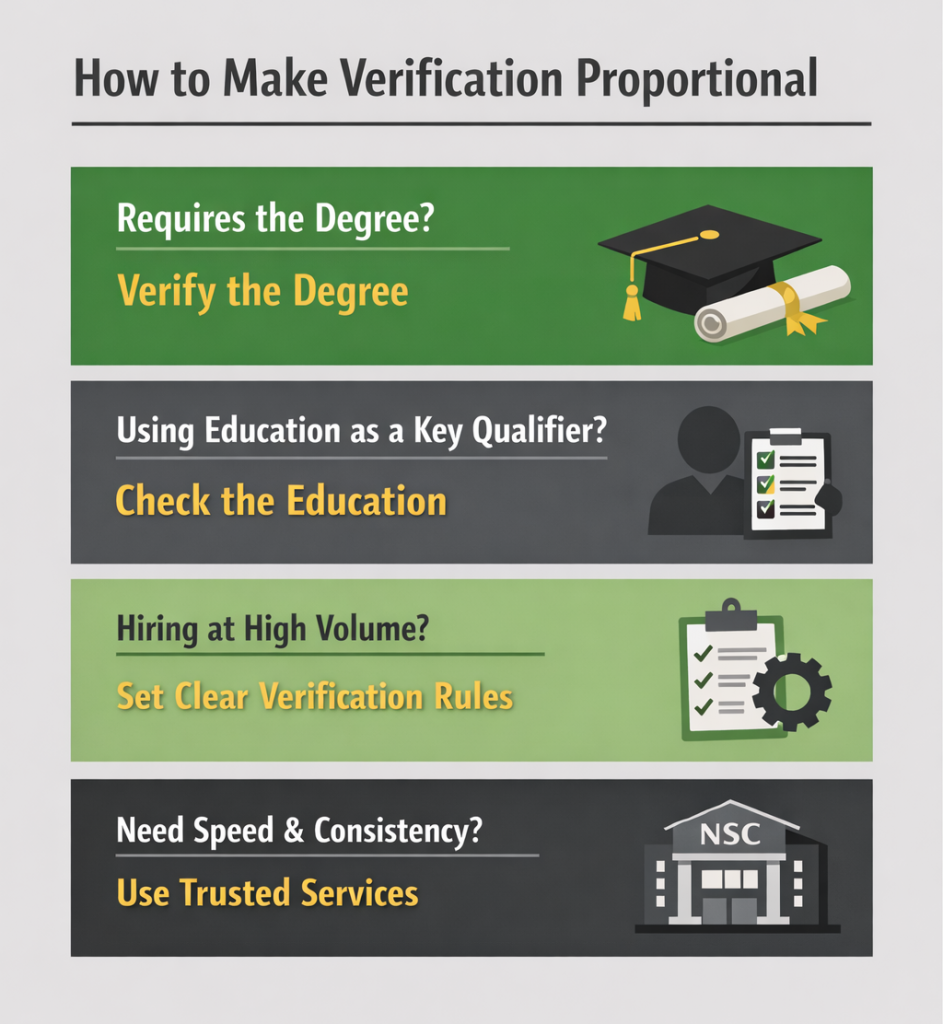
Proportional verification means matching the depth of verification to the role’s risk level and the way the credential is being used in the hiring decision.
If the role genuinely requires a degree, verify the degree. If the role does not require a degree, consider verifying only when the candidate is using education as a key qualifying factor. If you are hiring at high volume, build a consistent rule that triggers verification at the right stage so your team is not re-deciding the same question repeatedly.
When speed matters, reputable verification services can streamline degree and enrollment confirmations, which reduces manual back-and-forth with institutions. The National Student Clearinghouse is one widely used source for education verification services for employers and background screeners.
Common Over-Screening Mistakes That Slow Hiring
Over-screening usually shows up in a few predictable ways. Employers require a degree verification for roles where the degree does not affect the ability to perform the job. Teams verify every credential even when a credential is not being used in the selection decision. Hiring managers add “nice-to-have” degree language that quietly becomes treated as a hard requirement.
Each of these increases cycle time and candidate frustration, and it makes your process harder to defend if challenged because the business purpose is unclear.
How Private Eyes Makes Education Verification for Employment Easier and More Defensible
Private Eyes Background Check Services helps employers verify education in a way that stays consistent, practical, and aligned to changing expectations.
We work with clients to build role-based screening rules so education verification is proportional to the position, not applied randomly. We also stay current on common credential fraud patterns and verification best practices, including how to spot red flags tied to diploma mills and unrecognized institutions, and how to validate accreditation using reliable sources like the U.S. Department of Education’s accreditation resources.
The result is a smoother workflow for recruiters and a cleaner decision trail for leadership.
If your hiring team is spending too much time chasing diplomas, or not verifying the credentials that truly matter, Private Eyes can help you tighten the process.
Contact Private Eyes to set up an education verification for an employment program that is role-based, reduces rework, improves consistency, and keeps your hiring moving.
Key Takeaways
- Education verification for employment matters most when a credential is truly job-related or tied to risk and oversight.
- Diploma mills can create real employer exposure, even when documents look legitimate.
- Accreditation checks using U.S. Department of Education resources help reduce credential fraud risk.
- Role-based education verification helps you verify what matters without slowing down every hire.
- A proportional approach improves candidate experience and keeps decisions consistent.
Have questions? Speak to a Private Eyes expert for more information.