


Fair Chance Hiring Laws 2026: The New Rules of Background Checks (and How to Stay Ahead)
Picture this. Your recruiter finally finds a strong candidate, the hiring manager is excited, and the start date is within reach. Then someone asks the question that can derail the whole moment.
“Can we run the background check yet?”
In 2026, that one sentence can mean the difference between a smooth hire and a messy stop-and-start process that frustrates candidates, burns recruiter time, and creates compliance risk you never intended to take on. Fair Chance hiring laws 2026 are tightening the timing and the steps around criminal history screening, while Clean Slate laws are quietly changing what records will show up at all.
The employers who thrive in this new landscape are not the ones who try to memorize every rule. They are the ones who build a hiring workflow that is consistent, documented, and respectful of the candidate experience.
Below is the practical playbook for doing exactly that.
What Clean Slate Changes for Employers
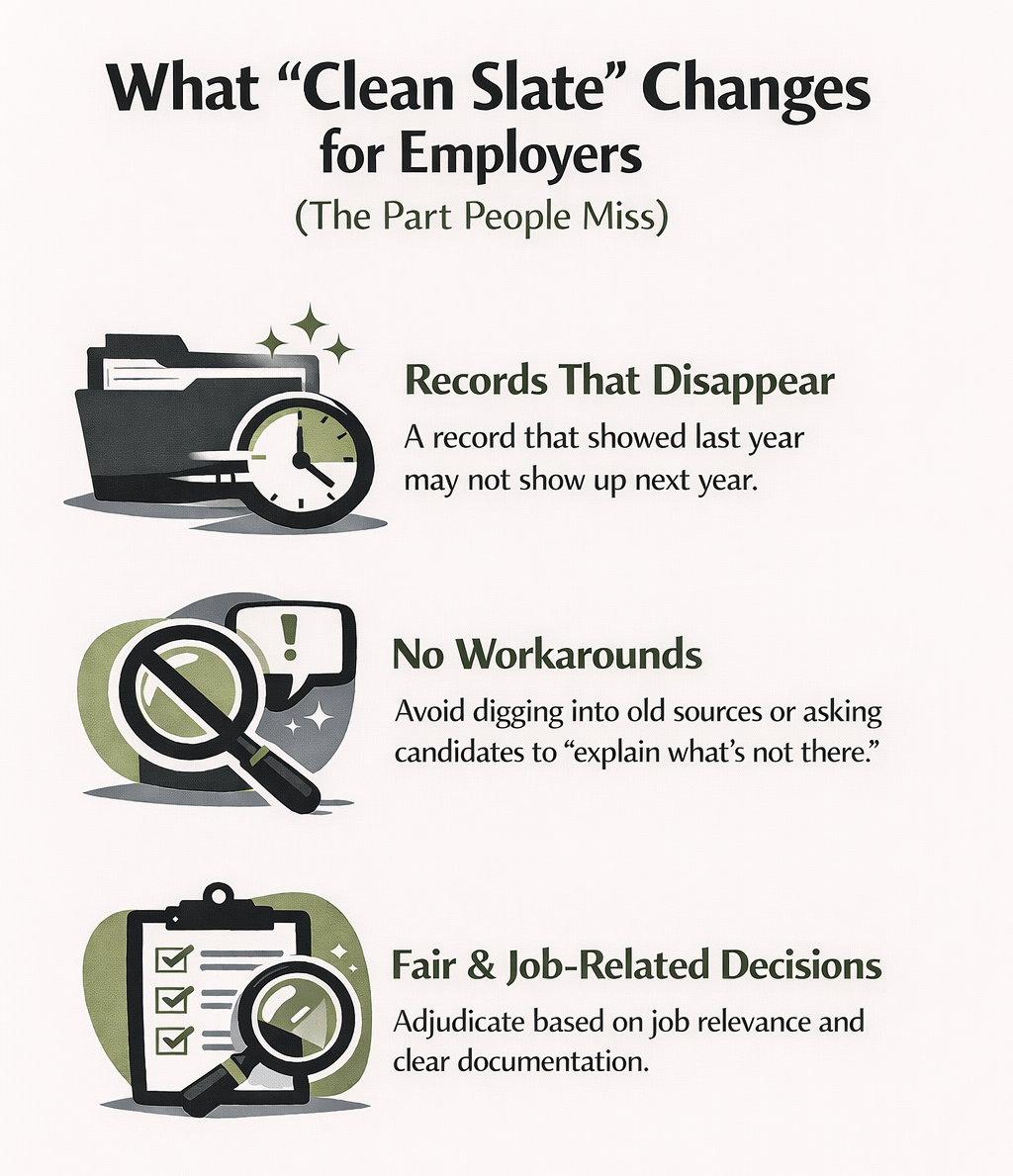
Clean Slate is where many employers get surprised. As automatic sealing expands, you can run the same search you ran last quarter and see fewer items than you used to. That is not a “problem with the background check.” It is the legal landscape doing what it was designed to do.
The real risk shows up when teams fill the gap with inconsistent judgment. One manager treats a result as a dealbreaker, another manager shrugs at it, and suddenly your hiring decisions look uneven. The cleaner approach is to base decisions on job relevance and to document the reasoning in a way you can explain later with confidence.
How Fair Chance Hiring Laws 2026 Change Screening
Fair Chance and Ban-the-Box rules are mostly about order of operations. In many stricter jurisdictions, the early stages of hiring must stay focused on qualifications, not criminal history. That often means you cannot ask about convictions on the application, and you may need to wait to request a criminal background report until after you have made a conditional offer.
These rules also tend to require a predictable process if you might withdraw an offer based on report results. The common theme is an individualized review plus clear written notices that give the candidate a real opportunity to respond.
California shows how structured this can be in practice. Employers generally treat criminal history screening as a post-offer step and use a documented individualized assessment before taking adverse action.
 California: The “Build Your Process Around This” State
If you hire anywhere in the country, California is still the best state to use as your design standard. A California-ready workflow is easier to train, easier to audit, and far less likely to break when you expand into a stricter city or add a new hiring location.
The key shift is to stop letting criminal history creep into early conversations. Treat it as a controlled step with a clear trigger point, consistent documentation, and a repeatable decision method.
Nevada: Less Uniform Statewide, But Consistency Still Wins
Nevada does not mirror California across the board for private employers, and that difference can tempt teams to run two separate hiring processes. That is where trouble starts. Recruiters move fast, hiring managers improvise, and the “Nevada version” and the “California version” get blended in real life.
For multi-state employers, the easiest way to reduce mistakes is to keep one standard sequence in both places. Make the conditional offer the line in the sand, then run the check. Consistency is what keeps your process smooth.
Major States and Cities That Drive Your 2026 Process
Most compliance headaches come from the places you did not plan for. You might build a workflow for one state and then discover you have candidates in a major city with an extra layer of rules.
That is why many employers pick a strict, uniform national workflow and then add location-based overlays only where necessary. When you do it this way, recruiters follow one playbook, and your system handles the exceptions behind the scenes.
A Defensible Workflow Under Fair Chance Hiring Laws 2026
A defensible workflow is not complicated, but it must be consistent. Keep criminal history out of the early stages. Extend a conditional offer. Then request the background report.
If results raise a concern, do not jump straight to a decision. Use a written individualized assessment that connects the information to the position and considers relevance and time elapsed. After that, follow the pre-adverse and final adverse action steps, and keep clean records of what was sent and when.
What to Change First to Align With Fair Chance Hiring Laws 2026
The fastest improvements are operational. Start by removing criminal history questions from applications and recruiter scripts so the early-stage habit disappears everywhere. Next, set your applicant tracking system (ATS) so criminal background checks cannot be ordered before the correct stage. If you want to eliminate location errors entirely, make the conditional offer the trigger nationwide.
Then, require a standardized individualized assessment before any offer is withdrawn based on criminal history. Finally, standardize your adverse action notices and track delivery dates and waiting periods so you can prove your process was followed.
How Private Eyes Makes Background Screening Smoother as Laws Change
Keeping up with Fair Chance hiring laws 2026 and Clean Slate rollouts is not a one-time update. It is ongoing, and it affects day-to-day hiring operations.
Private Eyes Background Check Services helps employers turn changing rules into a smoother workflow. We build screening programs that use a consistent national sequence, then apply location-specific overlays where needed. As laws change, we monitor updates that affect ordering timing, disclosures and authorizations, individualized assessment expectations, and adverse action steps so your team does not have to start from scratch every time a rule shifts.
We also focus on usability. That means practical templates, clear decision documentation, and system-friendly steps that work inside your recruiting process, not beside it.
If your team is navigating Fair Chance hiring laws 2026 across California, Nevada, or multiple major markets, Private Eyes can help you stay compliant while keeping hiring moving.
Key Takeaways
- Fair Chance hiring laws 2026 increasingly require criminal history checks to happen later in the process, often after a conditional offer.
- Clean Slate programs can reduce what appears on reports over time, so consistent decision-making matters.
- One nationwide workflow is easier to train and reduces location-based mistakes.
- A written individualized assessment helps keep decisions job-related and defensible.
- Standardized adverse action steps and tracked timelines protect both the candidate experience and your compliance posture.
Have questions? Speak to a Private Eyes expert for more information.