


Employment Background Check: The Complete Guide for Employers (2026)
Hiring the right employee is one of the most important decisions a business can make. Every new hire affects productivity, workplace culture, customer trust, and, ultimately, your organization’s reputation. While interviews and résumés provide valuable insight into a candidate’s qualifications, they don’t always reveal the complete picture.
That’s why employment background checks have become a standard part of the hiring process. They help employers verify critical information, reduce hiring risks, and make informed decisions based on facts rather than assumptions.
In 2026, background screening is about far more than identifying red flags. It is a tool for confirming credentials, protecting company assets, meeting industry regulations, and building a safer workplace. When used correctly, background checks strengthen hiring decisions while promoting fairness and compliance.
This guide explains what employment background checks involve, why they matter, and how employers can use them effectively.
What Is an Employment Background Check?
An employment background check is the process of verifying information provided by a job applicant before extending or finalizing an offer of employment. Rather than relying solely on a résumé or interview, employers use independent sources to confirm a candidate’s identity, qualifications, and professional history.
The scope of a background check depends on the position and the employer’s industry. A financial institution, for example, may require extensive screening because employees handle sensitive financial data. A healthcare organization may need additional checks to comply with patient safety regulations.
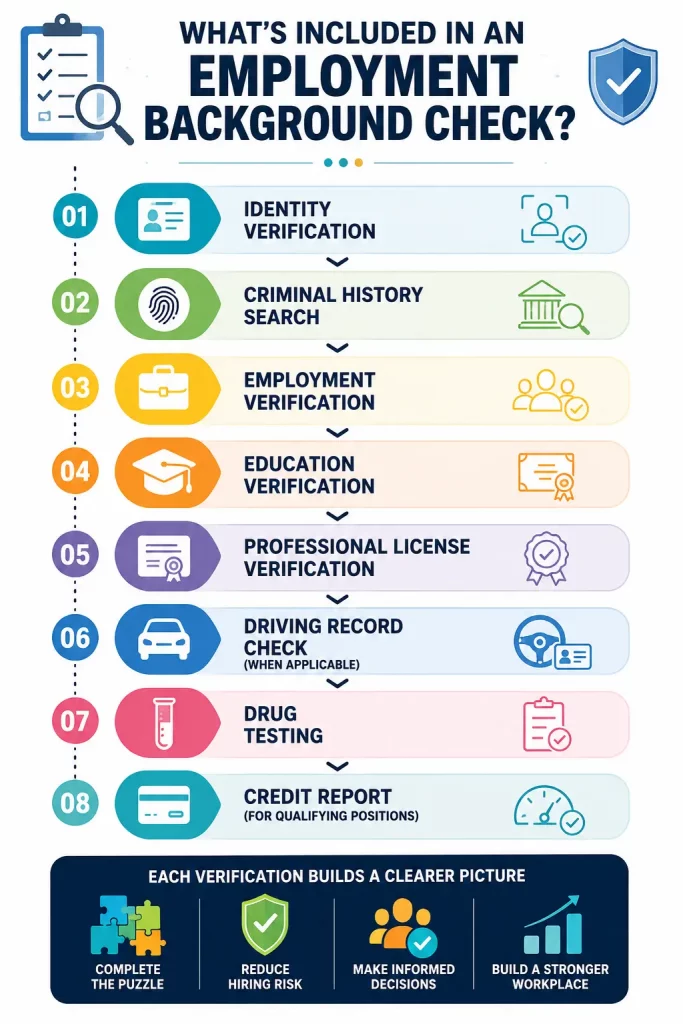
Common components include:
- Identity verification
- Criminal history searches
- Employment verification
- Education verification
- Professional license verification
- Driving record checks (when applicable)
- Drug testing
- Credit reports for qualifying positions
Each component serves a different purpose. Together, they provide a clearer understanding of whether an applicant meets the requirements of the role.
Why Employment Background Checks Matter
A background check is not about assuming applicants have something to hide. Its primary purpose is verification.
Employers routinely receive applications containing inaccurate employment dates, exaggerated responsibilities, or educational credentials that cannot be confirmed. Some discrepancies are simple mistakes, while others are intentional misrepresentations.
Verifying information early helps organizations avoid costly hiring errors.
The consequences of a poor hiring decision extend well beyond recruiting expenses. A bad hire may reduce team productivity, increase turnover, create legal exposure, damage customer relationships, or compromise workplace safety. Replacing an employee can cost thousands of dollars once recruiting, onboarding, training, and lost productivity are considered.
Background checks provide objective information that allows employers to make decisions with greater confidence instead of relying on assumptions.
What Information Can Employers Verify?
Many employers assume background checks only involve criminal records. In reality, criminal history represents just one part of the screening process.
Professional verification often includes confirming:
- Previous employers
- Job titles
- Employment dates
- Degrees and certifications
- Professional licenses
- Identity documents
- Driving history
- Drug screening results
- Credit history (when legally permitted)
Each verification answers a different question.
Employment verification confirms whether a candidate actually worked where they claimed.
Education verification ensures required degrees were earned from accredited institutions.
Identity verification helps prevent identity fraud and ensures records belong to the correct individual.
Taken together, these verifications create a more complete and accurate hiring profile.
Choosing the Right Level of Screening
Not every position requires the same level of investigation.
A retail cashier and a chief financial officer face very different responsibilities. Screening should reflect the level of trust, access, and risk associated with each role.
For example:
- Customer service representatives may only require identity verification and employment history.
- Commercial drivers often require motor vehicle record checks.
- Healthcare professionals may require license verification, sanctions searches, and criminal history screening.
- Financial professionals frequently undergo additional identity verification and credit screening where permitted by law.
Matching the screening package to the position helps employers remain compliant while avoiding unnecessary costs.
Identity Verification Is Becoming More Important Than Ever
Identity fraud continues to evolve, making identity verification one of the fastest-growing areas of employment screening.
Remote hiring has increased opportunities for applicants to submit altered documents, use stolen identities, or misrepresent themselves during virtual recruiting.
Modern verification methods may include:
- Government-issued ID authentication
- Social Security number verification
- Address history verification
- Identity fraud detection
- Biometric verification in certain industries
Verifying identity first improves the accuracy of every subsequent search because the screening is performed on the correct individual.
Criminal Background Checks Require Context
Criminal history searches often receive the most attention, but they should never be viewed in isolation.
A criminal record does not automatically determine whether someone is qualified for employment. Employers should consider factors such as:
- The nature of the offense
- How long ago it occurred
- Whether it relates to the responsibilities of the position
- Evidence of rehabilitation
- Applicable federal, state, and local laws
Many jurisdictions have adopted “Ban the Box” or Fair Chance Hiring laws that regulate when employers may ask about criminal history or how criminal records may be considered.
Thoughtful evaluation helps employers balance workplace safety with fair hiring practices.
Compliance Is Just as Important as Screening
A background check that violates employment laws can create significant legal risk.
In the United States, employers using third-party screening companies must comply with the Fair Credit Reporting Act (FCRA). Among other requirements, employers must:
- Obtain written authorization before conducting a background check.
- Provide required disclosures.
- Follow the adverse action process before denying employment based on screening results.
Many states also have additional privacy laws, salary history restrictions, and fair chance hiring regulations.
Working with an experienced background screening provider helps employers remain compliant while reducing administrative burden.
Common Mistakes Employers Should Avoid
Even well-intentioned employers can make screening mistakes that affect hiring decisions.
One common mistake is applying the same screening package to every position without considering actual job responsibilities.
Another is relying solely on online databases. Many public databases contain incomplete or outdated information, which is why professional verification remains essential.
Employers also risk making decisions before allowing applicants an opportunity to explain discrepancies or correct inaccurate information.
Finally, choosing a background check provider based only on price often results in slower turnaround times, weaker verification methods, or limited customer support. The true value lies in accuracy, compliance, and reliable reporting, not simply the lowest cost.
How to Choose a Background Check Provider
Not all background screening companies deliver the same level of service.
When evaluating providers, look for a company that offers:
- Accurate identity verification
- Comprehensive employment and education verification
- FCRA-compliant processes
- Transparent reporting
- Responsive customer support
- Industry-specific screening packages
- Fast turnaround times without sacrificing quality
An experienced provider should also help employers understand compliance requirements rather than simply delivering reports. Understanding background check turnaround times can also help employers set realistic hiring expectations and recognize the factors that may influence the screening process.
The right partner becomes an extension of your hiring process, helping your organization make informed decisions with confidence.
The Future of Employment Background Checks
Technology is transforming employment screening.
Artificial intelligence is helping automate administrative tasks, while digital identity verification, secure document authentication, and electronic records are reducing turnaround times.
At the same time, privacy regulations continue to evolve, requiring employers to balance faster hiring with responsible data handling.
The future of background screening will likely emphasize three priorities:
- Stronger identity verification
- Greater transparency for applicants
- More efficient, technology-driven screening processes
Organizations that embrace these changes will be better positioned to hire qualified candidates while maintaining compliance and protecting sensitive information.
Key Takeaways
- Employment background checks help employers make informed hiring decisions. By verifying a candidate’s identity, qualifications, and work history, organizations can reduce hiring risks and build stronger teams.
- Every position requires a different level of screening. The scope of a background check should reflect the responsibilities and level of risk associated with the role, rather than applying a one-size-fits-all approach.
- Verification is more valuable than assumption. Employment, education, professional licenses, and identity should all be confirmed through reliable sources instead of relying solely on résumés or interviews.
- Compliance is essential throughout the screening process. Employers should follow the Fair Credit Reporting Act (FCRA) and any applicable state or local laws to protect both their organization and job applicants.
- Identity verification is becoming increasingly important. As remote hiring grows and identity fraud becomes more sophisticated, verifying an applicant’s identity is a critical first step in any employment screening program.
- Choosing the right background check provider matters. A reputable screening partner delivers accurate reports, supports compliance, provides responsive customer service, and helps employers make confident hiring decisions.
- Background checks are an investment in long-term success. Beyond reducing risk, a well-designed screening process contributes to workplace safety, regulatory compliance, and better hiring outcomes that support organizational growth.
Have questions? Speak to a Private Eyes expert for more information.