


Income Verification for Lenders: Best Practices to Reduce Risk and Speed Up Loan Decisions
Every lending decision begins with one fundamental question: Can this borrower realistically repay the loan?
The answer depends largely on the quality of income verification. In an environment where forged pay stubs, manipulated bank statements, and synthetic identities have become increasingly sophisticated, relying on documents at face value is no longer enough. Lenders must validate not only how much an applicant earns, but also whether that income is stable, legitimate, and likely to continue.
At the same time, borrowers expect fast approvals. Lengthy verification processes can frustrate applicants, delay closings, and increase operational costs. The challenge for lenders is balancing speed with accuracy.
Modern income verification is not simply a compliance requirement. It is a strategic tool for reducing risk, preventing fraud, and creating a more efficient lending process.
Why Income Verification Is More Than a Compliance Step
Many people view income verification as a box to check before underwriting begins. In reality, it influences nearly every aspect of loan quality.
Verified income affects debt-to-income calculations, repayment capacity, pricing decisions, and ultimately the long-term performance of the loan portfolio. If the underlying income data is inaccurate, every decision built on that information becomes less reliable.
This becomes especially important during periods of economic uncertainty. Borrowers may experience fluctuating work hours, multiple income streams, gig employment, or recent job changes that complicate traditional verification methods. A simple pay stub rarely tells the complete financial story.
By verifying income through reliable sources, lenders gain a clearer understanding of a borrower’s financial stability instead of relying on assumptions.
Common Challenges Lenders Face During Income Verification
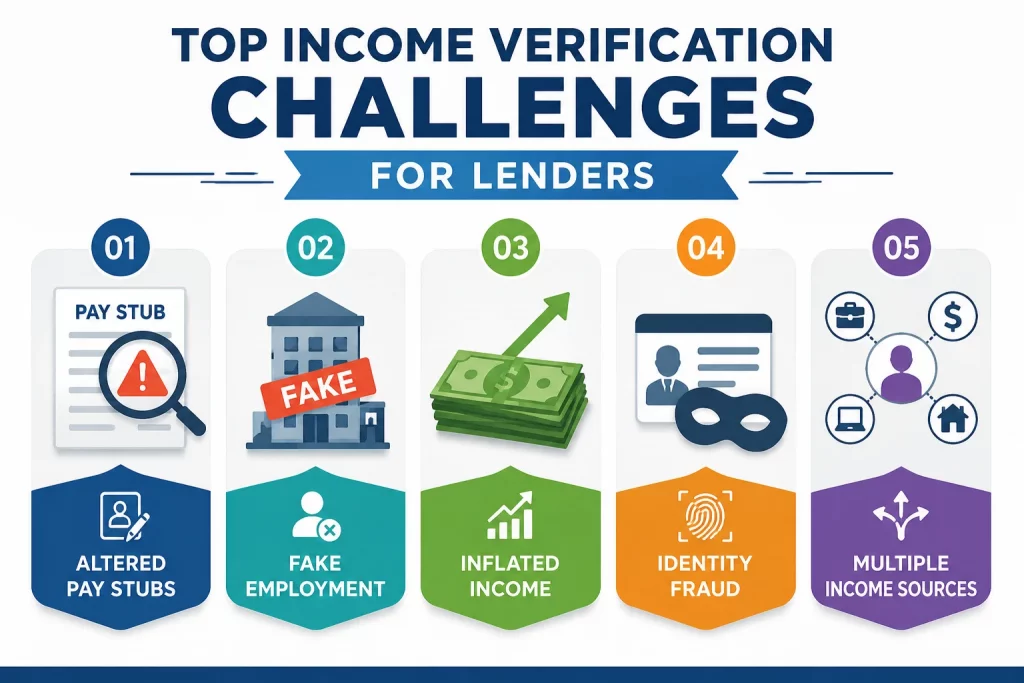
Income verification has become more complex as the workforce has evolved.
Traditional salaried employees remain relatively straightforward to verify, but many applicants no longer fit that profile. Self-employed professionals, independent contractors, freelancers, seasonal workers, and gig economy participants often receive income from multiple sources that vary throughout the year.
These situations require more than reviewing recent pay statements.
Lenders also face growing fraud risks, including:
- Altered pay stubs generated by online editing tools
- Fabricated employment verification letters
- Inflated income figures on loan applications
- Identity fraud used to support false employment claims
- Fake businesses created solely to obtain financing
The sophistication of document fraud means manual reviews alone may not detect inconsistencies. Instead, lenders increasingly combine document analysis with independent verification methods that validate information directly from trusted sources.
Best Practice #1: Verify Income Using Independent Data Sources
One of the strongest ways to reduce risk is to verify information independently rather than relying exclusively on borrower-provided documents.
Tax transcripts obtained through IRS authorization, employer verification, and trusted third-party verification services provide objective confirmation that income matches what was reported during the application process.
Independent verification helps identify discrepancies that may not be obvious during a standard file review.
For example, an applicant may provide pay stubs showing a recent salary increase, while historical tax transcripts reveal significantly different annual earnings. That difference does not necessarily indicate fraud, but it does warrant additional review before the loan proceeds.
Independent validation strengthens underwriting decisions because it removes much of the uncertainty surrounding borrower-provided documentation.
Best Practice #2: Look Beyond Current Income
Current income offers only a snapshot in time.
Strong underwriting considers whether that income is sustainable.
Questions worth evaluating include:
- Has the borrower recently changed jobs?
- Is compensation primarily commission-based?
- Does overtime represent a significant portion of earnings?
- Has income remained consistent over multiple years?
- Are there signs of declining business revenue for self-employed applicants?
Patterns often reveal more than isolated documents.
A borrower earning a high salary today may present greater repayment risk than someone with modest but consistent income over several years. Stability frequently matters more than temporary spikes in earnings.
Best Practice #3: Integrate Employment Verification Into the Process
Income and employment are closely connected, yet they are often verified separately.
A borrower may accurately report current income while employment circumstances have already changed. Layoffs, reduced hours, or temporary employment interruptions can significantly affect repayment ability before the loan even closes.
Verifying employment close to funding provides lenders with greater confidence that the financial picture remains accurate.
When employment verification is integrated into the broader underwriting workflow rather than treated as an isolated task, lenders reduce the likelihood of making decisions based on outdated information.
Best Practice #4: Use Technology to Improve Consistency
Manual verification processes create opportunities for delays and inconsistent decision-making.
Different reviewers may interpret the same documentation differently, increasing operational risk and reducing efficiency.
Modern verification platforms help standardize workflows by automating document collection, validating information against trusted databases, and flagging inconsistencies for further review.
Automation does not replace human judgment. Instead, it allows experienced underwriters to focus their expertise where it matters most: reviewing exceptions rather than performing repetitive administrative tasks.
The result is often faster processing times without sacrificing due diligence.
Best Practice #5: Build Fraud Detection Into Every Verification Workflow
Fraud prevention should not begin after suspicious documents are discovered. It should be built into the verification process from the start.
Effective fraud detection combines multiple verification methods rather than depending on a single document.
Examples include:
- Identity verification
- Employment verification
- IRS tax transcript verification
- Social Security number validation
- Document authenticity analysis
- Cross-checking borrower information across multiple data sources
Each verification layer provides another opportunity to identify inconsistencies before they become costly losses.
This layered approach is particularly valuable as synthetic identity fraud and document manipulation continue to evolve.
How IRS Tax Transcript Verification Strengthens Lending Decisions
Among the various verification methods available, IRS tax transcript verification remains one of the most reliable for confirming reported income.
Unlike documents supplied directly by borrowers, IRS transcripts originate from official tax filings, providing lenders with an independent source for evaluating historical earnings.
Tax transcript verification is especially useful for:
- Self-employed borrowers
- Applicants with multiple income sources
- Investment property financing
- High-balance mortgage applications
- Situations where income documentation appears inconsistent
Rather than replacing other verification methods, tax transcripts complement employment and identity verification to create a more complete financial profile.
Balancing Speed With Thorough Due Diligence
Borrowers increasingly expect rapid loan decisions, but faster does not have to mean less accurate.
The most efficient lenders eliminate unnecessary manual steps while strengthening verification where it matters most. Automation, standardized workflows, and reliable third-party verification partners reduce administrative bottlenecks without compromising underwriting quality.
Instead of asking employees to spend hours validating documents manually, organizations can devote more attention to complex files that require professional judgment.
This balance improves both the borrower experience and operational efficiency.
Choosing the Right Income Verification Partner
Not every verification provider offers the same level of reliability or service.
When evaluating a partner, lenders should consider factors beyond turnaround time, including data accuracy, regulatory compliance, integration capabilities, and the breadth of available verification services.
An ideal provider supports the entire verification process, including income confirmation, employment verification, identity verification, IRS transcript retrieval, and fraud prevention tools. Identity verification becomes even more effective when combined with an understanding of the five red flags that may signal borrower identity fraud, helping lenders identify suspicious applications before they move through underwriting.
Choosing a comprehensive partner reduces the need to manage multiple vendors while helping underwriting teams make faster, more informed decisions.
Key Takeaways
- Income verification is a critical component of sound underwriting because it directly influences lending decisions, portfolio performance, and risk management.
- Independent verification methods, such as IRS tax transcript verification and employment verification, provide greater confidence than borrower-submitted documents alone.
- Evaluating income stability over time often provides a more accurate picture of repayment ability than reviewing current earnings in isolation.
- Technology and automation improve consistency, reduce processing delays, and allow underwriters to focus on higher-risk applications that require professional judgment.
- Layering income verification with identity verification, fraud detection, and employment verification creates a stronger defense against increasingly sophisticated fraud schemes.
- Partnering with a trusted verification provider can streamline workflows, improve compliance, and help lenders make faster, more informed lending decisions.
Have questions? Speak to a Private Eyes expert for more information.