


Why 4506-C Still Matters for Modern Lending
For a lot of lending teams, Form 4506-C can feel like an old-school step that slows files down. Borrowers dislike paperwork, loan officers dislike rework, and processors dislike the suspense of waiting on transcripts.
But here is the reality in 2026. If you are selling into the secondary market, managing rep and warranty exposure, or trying to reduce fraud losses, 4506-C is still one of the cleanest ways to confirm that the income story in your file matches what was actually filed.
The IRS Income Verification Express Service (IVES) exists to let taxpayers authorize third parties to access tax transcripts for lending decisions, and 4506-C is the standard consent form used through that program.
What 4506-C Actually Does
Form 4506-C is the borrower’s written authorization that allows an IVES participant to request IRS tax transcripts on the lender’s behalf. It is designed for use within IVES, and incomplete or illegible forms can be rejected.
This matters because the transcript is not just another document. It is an independent data source that helps you validate key claims in the file, spot inconsistencies, and demonstrate that you followed your underwriting and quality control expectations.
The Part Leadership Cares About: Rep and Warranty Risk
When a loan is reviewed after closing, the question is rarely, “Did you intend to do the right thing?” It is, “Did your file show you did the right thing?”
Agency and investor guidance has long treated transcript validation as a key control in reverifying income and detecting misrepresentation. For example, Fannie Mae’s Selling Guide addresses the use of Form 4506-C through IVES.
From a risk perspective, transcripts strengthen the story your file tells during quality control, post-closing audits, and investor reviews. They help show that the income used to qualify was approached with appropriate diligence, and they can reduce the “he said, she said” problem when a file is challenged later.
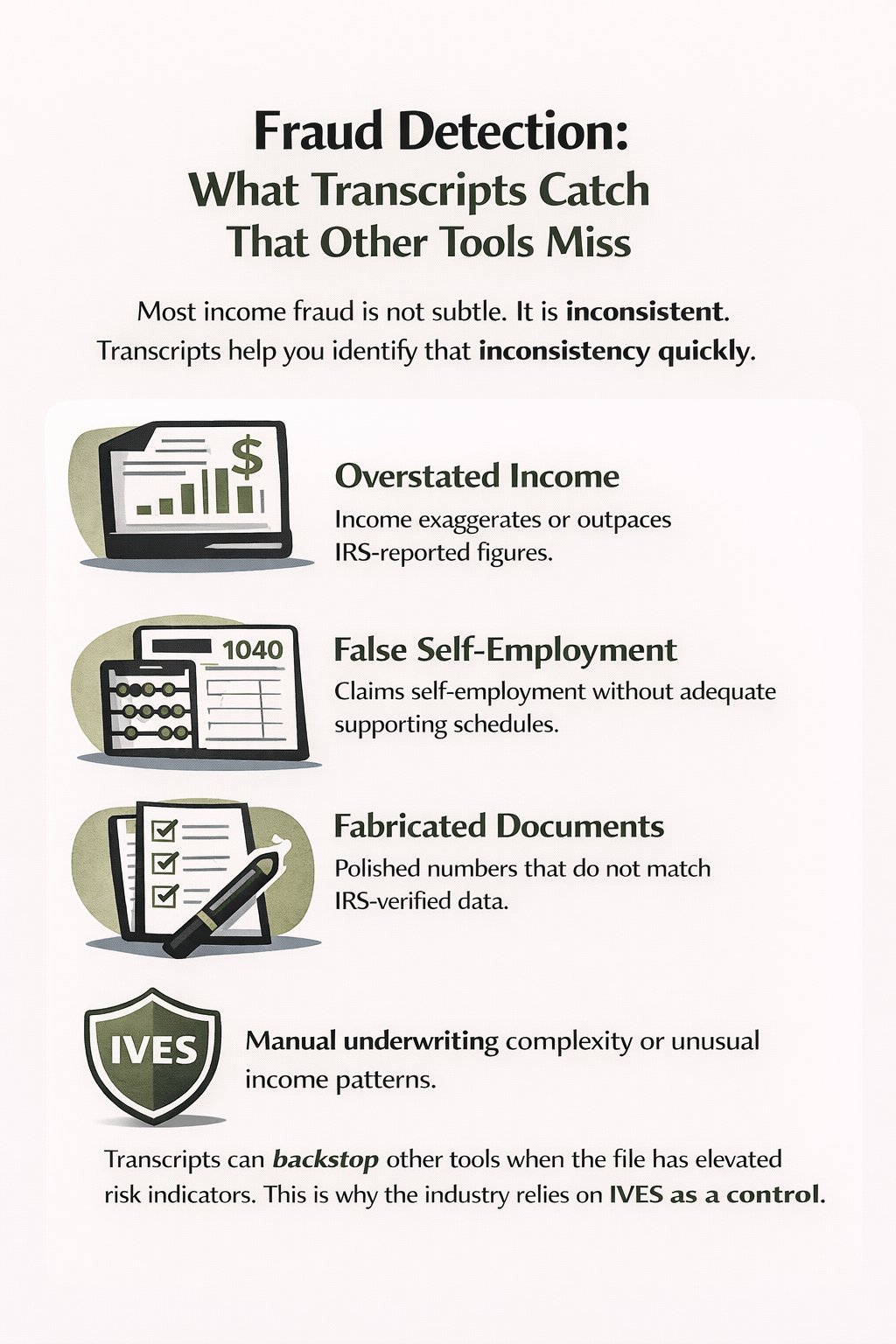
Fraud Detection: What Transcripts Catch That Other Tools Miss
Most income fraud is not subtle. It is inconsistent.
Transcripts help you identify that inconsistency quickly. Common examples include income that is overstated compared to what was filed, self-employment claims that do not line up with filed schedules, or documents that look polished but do not match IRS-reported figures.
Even when you have other verification tools, transcripts can serve as a backstop when the file has elevated risk indicators, unusual income patterns, or manual underwriting complexity. This is one reason the industry continues to rely on IVES as a control.
Consistency Checks: The Quiet Value That Makes Operations Better
4506-C is not only an anti-fraud tool. It is also a consistency tool.
When you standardize transcript validation across products or borrower types, you reduce judgment calls and reduce variance between branches and teams. That leads to cleaner quality control outcomes and fewer surprises at the finish line.
It also supports better internal explanations. When someone asks, “Why do we still do this?” you can answer clearly: it is about file integrity, consistent controls, and downstream risk reduction.
Where 4506-C Breaks Down in Real Life
Most friction with 4506-C is not ideological. It is operational.
The first issue is form execution. The IRS form instructs borrowers not to sign unless all applicable lines have been completed, and incomplete forms can be rejected. A single missing field, mismatch in name, or unclear tax period can turn into a start-over cycle.
The second issue is timing. If the form is obtained late, any problem becomes a closing fire drill. Getting a clean, executable 4506-C early gives you room to correct errors without compressing the timeline.
The third issue is expectations. When teams treat transcripts as optional until the file looks risky, they end up with inconsistent controls and inconsistent outcomes. That inconsistency is exactly what quality control and investors dislike.
A Practical Best-Practice Approach That Keeps Files Moving
The simplest practice-focused approach is to treat 4506-C as a standard part of intake for loans where transcripts are needed for your product, investor, or quality control plan, and to standardize execution so you stop re-learning the same lessons on every file.
That means training staff on common form errors, using a consistent checklist for completeness, and building a single workflow that does not depend on individual judgment. It also means documenting how transcript results were reviewed and what you did when something did not match.
If you sell to or align with agency requirements, it is worth keeping a close eye on the guidance relevant to your channel and product set, since those policies can evolve and should feed directly into your quality control plan and closing checklists.
How Private Eyes Makes 4506-C Smoother and More Reliable
Private Eyes supports lenders who want transcript verification to be a strength, not a bottleneck.
We stay current on IVES process expectations and on how major investor and agency guidance treats transcript authorization and retention, so your workflow does not drift while the rules evolve.
On the practical side, we help reduce rework by focusing on clean execution, consistent packaging, and clear exception handling when discrepancies appear. That means fewer last-minute form corrections, fewer avoidable rejections, and a smoother path from underwriting to closing to quality control.
If your team is debating why 4506-C still matters, the better question is whether you can afford inconsistent income controls in today’s fraud environment.
Reach out to Private Eyes to strengthen your 4506-C and transcript verification workflow so you can close with confidence, reduce rep and warranty exposure, and keep your process moving.
Key Takeaways
- 4506-C supports income validation through the IRS IVES framework.
- Transcripts help reduce rep and warranty exposure by strengthening file defensibility.
- Transcripts can reveal inconsistencies that other documents and tools may miss.
- Most delays come from execution errors and late timing, not from the concept itself.
- A standardized process improves quality control outcomes and keeps lending operations consistent.
Ready to transform your lending experience? Contact us to get started and ensure efficiency and reliability in your loan approval processes.
Have questions? Speak to a Private Eyes expert for more information.